
Activity
Petrel Exploration
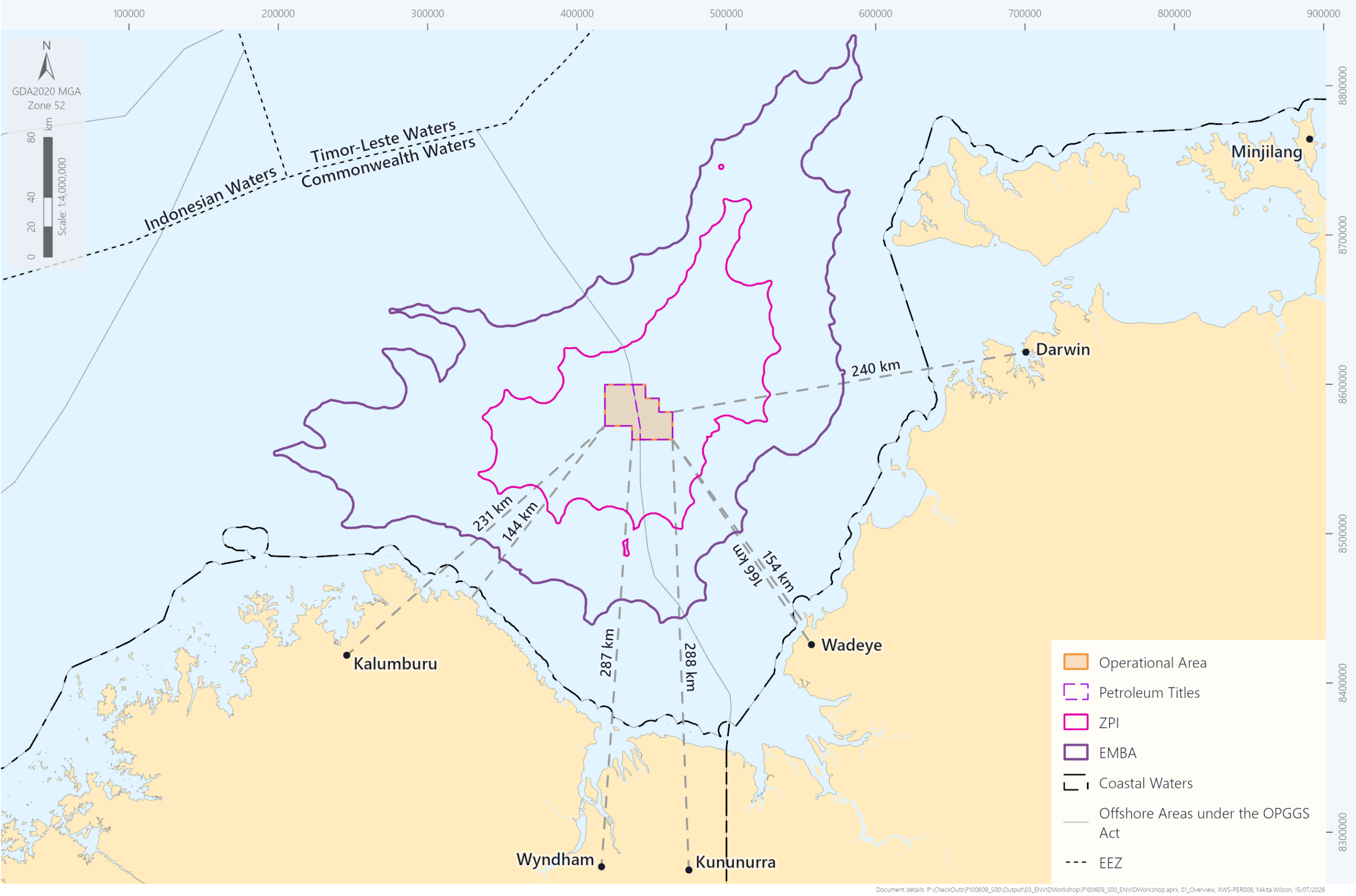
Eni, through its subsidiary Eni Energy Bonaparte Pty Ltd, is the titleholder of the Petrel Gas Field (Petrel) in the Bonaparte Basin in North Western Australia. The Petrel field, discovered in 1969, is located across two retention leases, NT/RL1 and WA-6-R, ~240km west of Darwin.
Eni is proposing to undertake exploration drilling within the Petrel retention leases in the Bonaparte Basin to support potential future Petrel exploration and development activities.
Eni proposes drilling between one to four exploration and/or appraisal wells over several campaigns, with the initial well forecast from mid-2028 in a single-well campaign.
Up to three additional wells may be drilled, either individually or in campaigns of multiple wells, within the remaining five-year validity of the EP. The timing of these subsequent activities has not been finalised.
Timeline
The Petrel Exploration Environment Plan will cover a period of five years from approval.
The initial well campaign is forecast from mid-2028.
Up to three subsequent wells may be undertaken at any time during the remainder of the EP validity period, in either single or multi-well campaigns.
Consultation opened on 31 August and will conclude on 12 October 2026.
Activity Resources

Environment
Petrel Exploration EMBA
The Environment That May Be Affected (EMBA) is derived from scientific modelling of multiple, plausible hydrocarbon spill events. This analysis combines hundreds of modelling simulations during a range of wind and current conditions and informs the risk assessment and spill response planning.
The final EMBA map is the outermost boundary of all the events considered. The actual footprint of any single possible event is expected to be much smaller.
The zone of potential impact (ZPI) or moderate exposure zone is smaller than the EMBA and represents the area where biological impacts may occur due to hydrocarbons released to the environment in the event of a vessel collision. The outermost boundary of the EMBA is based on the combined modelling outputs of two separate and highly unlikely hydrocarbon release scenarios, including the unplanned release of marine diesel oil (MDO) resulting from a vessel collision, and the unplanned release of condensate following a loss of well control.
The loss of hydrocarbons to the environment is considered highly unlikely, and Eni implements a range of preventative measures to minimise this risk.
Refer to NOPSEMA’s news bulletin for information on oil spill modelling.
What Is An Environment Plan?
The Offshore Petroleum and Greenhouse Gas Storage Act 2006 (OPGGS Act) and associated regulations provides the legal framework for the exploration and recovery of petroleum and greenhouse gas activities in Commonwealth waters which are administered by the National Offshore Petroleum Safety and Environmental Management Authority (NOPSEMA).
The purpose of an Environment Plan (EP) is for the titleholder of an offshore petroleum or greenhouse gas permit, to document their case for why their Petroleum Activity or Greenhouse Gas Activity meets the objects of the Offshore Petroleum and Greenhouse Gas Storage (Environment) Regulations 2009 (OPGGS Environment Regulations).
An EP is a document submitted to NOPSEMA for assessment prior to the commencement of an activity, which contains information on:
- description of the activity
- description of the existing environment (natural, cultural and social)
- environmental risk assessment
- environmental management measures and commitments
- details of the titleholder and other information specified the OPGGS Environment Regulations.
Should I Be Consulted?
The activity will be assessed under the Offshore Petroleum and Greenhouse Gas Storage Act 2006 (OPGGS Act) and associated Regulations for the management of potential risks and impacts of the activity.
This process includes Eni’s assessment of stakeholders and relevant persons that have an interest in the activity.
Eni treats all information provided by you as confidential, with the exception of providing information to NOPSEMA. Eni is required to provide NOPSEMA with details of all correspondence with relevant persons, including copies of written correspondence.
Personal information (other than name and contact details) is sensitive information and will not be published in the EP. You can request that any material provided to Eni, including your name and contact details, be treated as sensitive information not to be published in the Petrel-3 and Petrel-4 Monitoring and Decommissioning Environment Plan.
Please let us know if your feedback for this activity is sensitive and we will make this known to NOPSEMA in order for this information to remain confidential to NOPSEMA.
