
Activity
Petrel Surveys
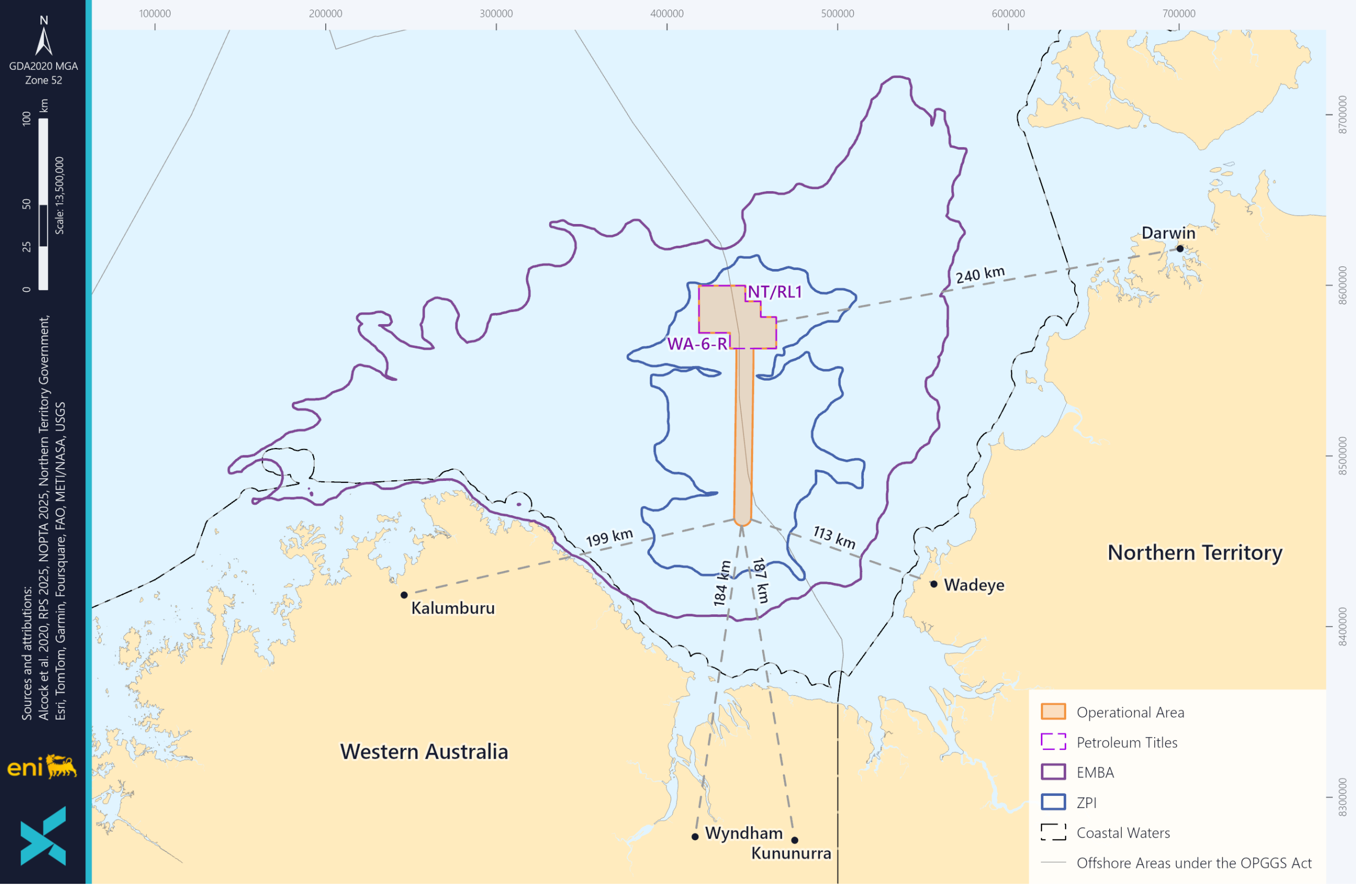
Eni through its subsidiary Eni, Energy Bonaparte Pty Ltd, is the titleholder of the Petrel Gas Field (Petrel) in the Bonaparte Basin in North Western Australia. The Petrel field is located across two retention leases, NT/RL1 and WA-6-R, ~250km west of Darwin.
Eni is proposing to undertake surveys within the Petrel field in the Bonaparte Basin to support the Petrel development and exploration activities within the Petrel field.
To better understand the existing environment and the seabed characteristics of the Petrel Development Area, Eni is proposing to undertake the following initial survey campaigns in 2026. Confirmed activity dates will be dependent on a number of factors including access approvals, vessel availability and weather conditions:
- Geotechnical survey, to help the design of the subsea structures.
- Geophysical survey, to get a baseline of what the seabed looks like, what’s underneath, and any hazards. This helps Eni to plan activities such as drilling, installing subsea equipment, and building wells.
- Environmental surveys, to understand the environmental conditions of the Petrel field
Subsequent surveys could be undertaken between 2027 and 2030.
Timeline
The Petrel Survey Environment Plan will cover a period of five years from 2026 to 2031.
The initial survey campaigns are proposed for Q3 and Q4 2026.
Subsequent surveys may be undertaken between 2027 and 2030.
Consultation opened on 27 January and will conclude on 17 March 2026.
Activity Resources

Environment
Petrel Surveys EMBA
The Environment That May Be Affected (EMBA) is the area within which the operations activities could have an environmental impact. The outermost boundary of the EMBA (for this activity) is based on an accidental release of marine diesel (MDO) to the environment in the unlikely event of a vessel collision damaging a fuel tank.
The final EMBA map is the outermost boundary of all the events considered. The actual footprint of any single possible event is expected to be much smaller.
The zone of potential impact (ZPI) or moderate exposure zone is smaller than the EMBA and represents the area where biological impacts may occur due to hydrocarbons released to the environment in the event of a vessel collision.
The loss of hydrocarbons to the environment is considered highly unlikely, and Eni implements a range of preventative measures to minimise this risk.
Refer to NOPSEMA’s news bulletin for information on oil spill modelling.
What Is An Environment Plan?
The Offshore Petroleum and Greenhouse Gas Storage Act 2006 (OPGGS Act) and associated regulations provides the legal framework for the exploration and recovery of petroleum and greenhouse gas activities in Commonwealth waters which are administered by the National Offshore Petroleum Safety and Environmental Management Authority (NOPSEMA).
The purpose of an Environment Plan (EP) is for the titleholder of an offshore petroleum or greenhouse gas permit, to document their case for why their Petroleum Activity or Greenhouse Gas Activity meets the objects of the Offshore Petroleum and Greenhouse Gas Storage (Environment) Regulations 2023 (OPGGS Environment Regulations).
An EP is a document submitted to NOPSEMA for assessment prior to the commencement of an activity, which contains information on:
- description of the activity
- description of the existing environment (natural, cultural and social)
- environmental risk assessment
- environmental management measures and commitments
- details of the titleholder and other information specified the OPGGS Environment Regulations.
Should I Be Consulted?
The activity will be assessed under the Offshore Petroleum and Greenhouse Gas Storage Act 2006 (OPGGS Act) and associated Regulations for the management of potential risks and impacts of the activity.
This process includes Eni’s assessment of stakeholders and relevant persons that have an interest in the activity.
Eni treats all information provided by you as confidential, with the exception of providing information to NOPSEMA. Eni is required to provide NOPSEMA with details of all correspondence with relevant persons, including copies of written correspondence.
